The decision that determines whether an attic foam job succeeds is not which foam. It is which plane.
You can foam the underside of the roof deck, which brings the attic inside the building envelope and makes it a conditioned space. Or you can foam the attic floor, which seals the ceiling plane and leaves the attic outside the envelope, vented as it always was.
Those are two different assemblies. They cost different amounts, they behave differently in a Binghamton winter, and one of them is wrong for your house. Most of the attic foam jobs we are called in to look at went wrong at this decision, not at the spray gun.
We do this work across Binghamton, Johnson City, Vestal, Endicott, Endwell, and the surrounding Broome County towns.
Attic Spray Foam Applications
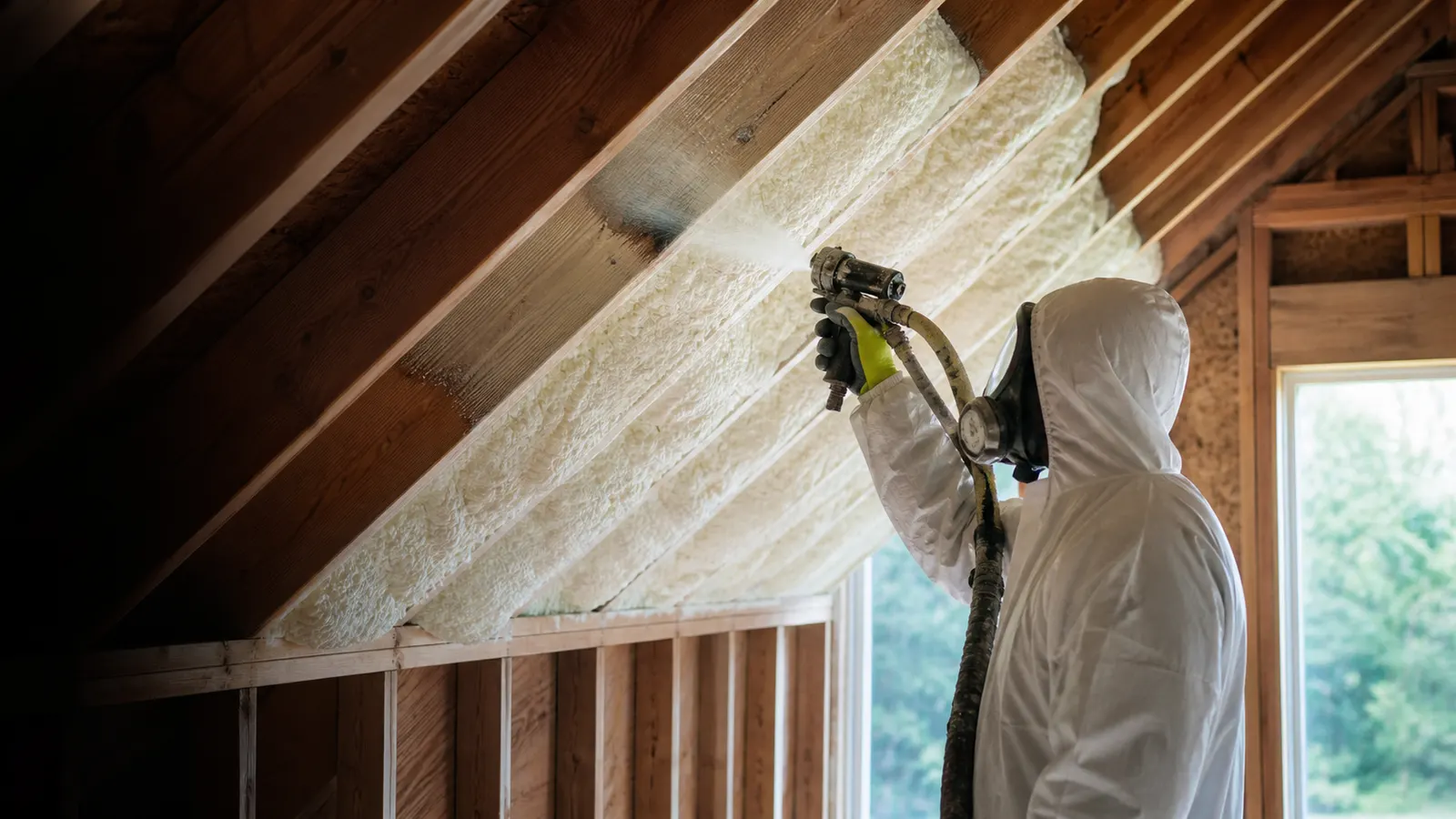
Vented attic with ductwork and a leaky ceiling below it; closed-cell foam applied to the underside of the roof deck, vents sealed; the attic becomes conditioned space and everything in it is now inside the envelope.
Where it belongs: attics containing ductwork or air handlers, attics with knee walls and complicated geometry that cannot be sealed at the floor, cathedral and vaulted assemblies, and houses where the attic is or will be used.
The code point that matters here: Broome County is in climate zone 6. Under the residential code, air-impermeable insulation at a roof deck in climate zones 5 through 8 must be a Class II vapor retarder or carry a Class II coating. In practice that means closed-cell foam at adequate thickness, or open-cell plus a separate Class II vapor retarder. There is no third option and this is not a preference.
Attic Floor and Ceiling Plane
Leaky ceiling plane with heat escaping into the attic; foam air barrier at the ceiling, attic stays vented; the ceiling is sealed and the attic stays cold, which is what a cold roof wants.
Where it belongs: simple, accessible attics with no ductwork, where the ceiling plane can genuinely be made continuous. Often the cheaper and the better answer, and it is frequently combined with blown cellulose over the top of the foam air barrier, which gets you depth at a lower cost per R.
The catch: every penetration has to be sealed. Recessed lights, plumbing stacks, chimney chases, wire penetrations, the attic hatch. Miss enough of them and you have paid for an air barrier with holes in it.
Knee Walls and Sloped Ceilings
The most common failure point in a one-and-a-half-story house, and the Southern Tier has a lot of them.
A knee wall has conditioned space on one side and vented attic on the other, and in most older houses it has fiberglass batts falling out of it with nothing holding them against anything. The sloped ceiling above it has a few inches of cavity and no room for a vent channel. These assemblies need to be thought about as a system, and the answer is usually to bring the whole thing inside the envelope by foaming the roofline through the sloped section.
Air Barrier at Penetrations and Chases
Whichever plane gets chosen, the penetrations are where the job is won or lost. Chimney chases, plumbing stacks, dropped soffits over kitchen cabinets, bathroom fan housings, and the attic hatch. On a ceiling-plane job these are the whole job. On a roofline job they matter less, which is one legitimate argument for the roofline in a house with a chaotic ceiling.
Which Plane Is Right for Your Roof?
A decision framework rather than a recommendation, because the answer is different for different houses.
Foam the roofline if:
- There is ductwork or an air handler in the attic. Leaving it outside the envelope means heating and cooling the attic on the way to the rooms.
- The attic geometry is complex: knee walls, dormers, multiple planes, sloped ceilings.
- The ceiling below has too many penetrations to seal reliably. Older houses with recessed lighting added over decades are typical.
- You want to use the space.
- The roof assembly has no functional venting anyway, which is common in cathedral and low-slope sections.
Foam the attic floor if:
- The attic is simple, open, accessible, and empty.
- There is no ductwork up there.
- The roof deck is in a condition you want to keep visible and inspectable.
- Budget matters and the ceiling plane is genuinely sealable.
Do not foam the roofline if:
- The roof covering is near the end of its life. Foam at the deck complicates a future tear-off and it means the deck cannot be inspected from below afterwards. If the roof is due in three years, do the roof first. We will say this and it will sometimes cost us the job this year.
- The sheathing is above 18% moisture content. Foaming over wet wood risks decay. We measure this before we spray, every time.
- There is an active roof leak. Fix it first. Foam over a leak means the water goes somewhere you cannot see.
Attic Spray Foam and Ice Dams in Broome County
Binghamton averages 83 inches of snow a year and freezing temperatures from November through April. Ice dams are not an occasional problem here; they are a design condition.
The mechanism: meltwater from higher on the roof refreezes lower down at the cold eave. The upper roof is warm enough to melt snow because heat is escaping into the attic from the house. The eave, which overhangs open air, is not.
What causes it, in order: air leakage from the house into the attic is the biggest cause by a distance, followed by insufficient insulation and thermal bridging, followed by heat sources in the attic like ducts and pipes. Building Science Corporation describes attic air leakage as “the most common, most damaging, and often the most obvious problem to solve.”
The fix order: air seal, then improve insulation, then remove or insulate attic heat sources, then waterproof membrane at the eaves as backup, then ventilation last, and only as a supplement. Ventilation cannot compensate for low insulation levels and thermal bridging.
What this means practically, and it is worth saying plainly: a new roof will not stop your ice dams. Ice barrier membrane at the eave limits the damage a dam does. It does nothing about why the dam forms. If a roofer has told you a new roof solves ice damming, that is not correct, and the correct sequence is to address the attic first.
Attic foam addresses exactly the first item on that list, air leakage, which is why it works on ice dams when adding more fiberglass over a leaky ceiling does not.
What If My Attic Already Has Insulation?
Common question and the answer varies more than people expect.
It can often stay, if the plan is a ceiling-plane job. Foam air sealing at the ceiling can go under existing loose fill in some configurations, or the existing material can be moved, the plane sealed, and the material put back. That is cheaper than removal.
It has to come out if the plan is a roofline job. Insulation at the ceiling plane in an attic that is being brought inside the envelope is now in the wrong place, and worse, it will trap the attic between two insulated planes with no conditioning, which is an assembly that causes problems.
It has to come out regardless if: it is wet, it is contaminated by rodents, it is vermiculite (which needs specialist assessment for asbestos content before anything is disturbed), or it is sitting on live knob-and-tube wiring.
Removal costs $0.75 to $2.00 per square foot and it is a real line item, not an afterthought. It is also unpleasant work and any quote that does not mention it on an attic that clearly has existing material should be questioned.
How the Attic Spray Foam Process Works
Assessment.
We go into the attic. We look at the geometry, find the ductwork, count and locate the penetrations, check the roof deck condition and its moisture content, look for evidence of past leaks or ice damming, and check for knob-and-tube. Then we tell you which plane makes sense and why, before either of us has committed to anything.
Written scope and itemized price.
Plane, product name, technical data sheet, depth, treated surface area, removal of existing material if any, containment plan, and the re-entry interval from the product sheet.
Removal and prep
, if existing material is coming out.
Containment.
The attic access is sealed off from the house, ventilation is set up, and everything below is protected. Occupants and pets out for the interval on the data sheet.
Application, photographed bay by bay.
Before and after. Once foam is on a roof deck, nobody sees that sheathing again.
Re-entry and post-cure verification.
We come back and thermal image the finished work, and you get the images.
Re-entry timing: EPA guidance is that occupants and other workers vacate during spray polyurethane foam installation, with re-entry restricted until the product has cured and the building has been ventilated and cleaned. For professional two-component systems, some manufacturers recommend around 24 hours; the interval is product-specific and the one that applies to your job is on the data sheet we give you.
Attic Spray Foam Cost Factors
Attic spray foam typically runs $3,000 to $8,000.
The variables, in rough order of how much they move the number:
- Which plane. The roofline of a house is usually a larger surface than its attic floor, sometimes twice as large. This is the single biggest driver and it is why “how much to foam my attic” cannot be answered on the phone.
- Depth, which is set by the assembly and the code, not by preference.
- Open cell versus closed cell, roughly double the material rate for closed-cell.
- Complexity. Knee walls, dormers, multiple planes, and low clearance all slow the work substantially.
- Existing material removal, at $0.75 to $2.00 per square foot.
- Access. A pull-down stair in a hallway is a different job from a hatch in a closet.
- Ductwork and obstructions that have to be worked around.
- Whether the house is occupied, which affects containment and scheduling.
Our spray foam cost guide for Binghamton works through a full attic example, priced at the ceiling plane and at the roofline.
Explore Our Foam Insulation Services
Foam Insulation
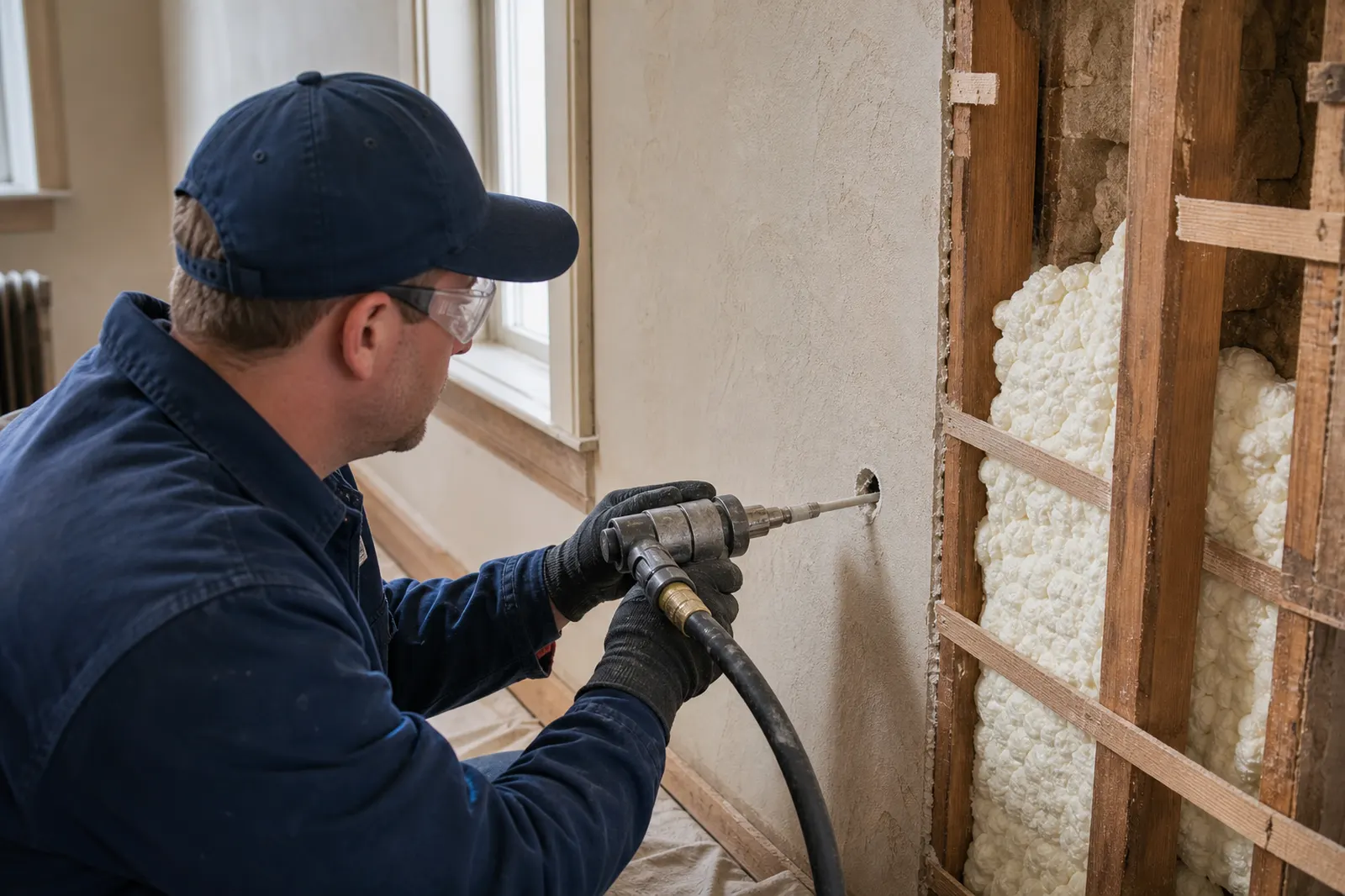
Everything we do, and the place to start if you are not sure which application yours is.Foam insulation in Binghamton.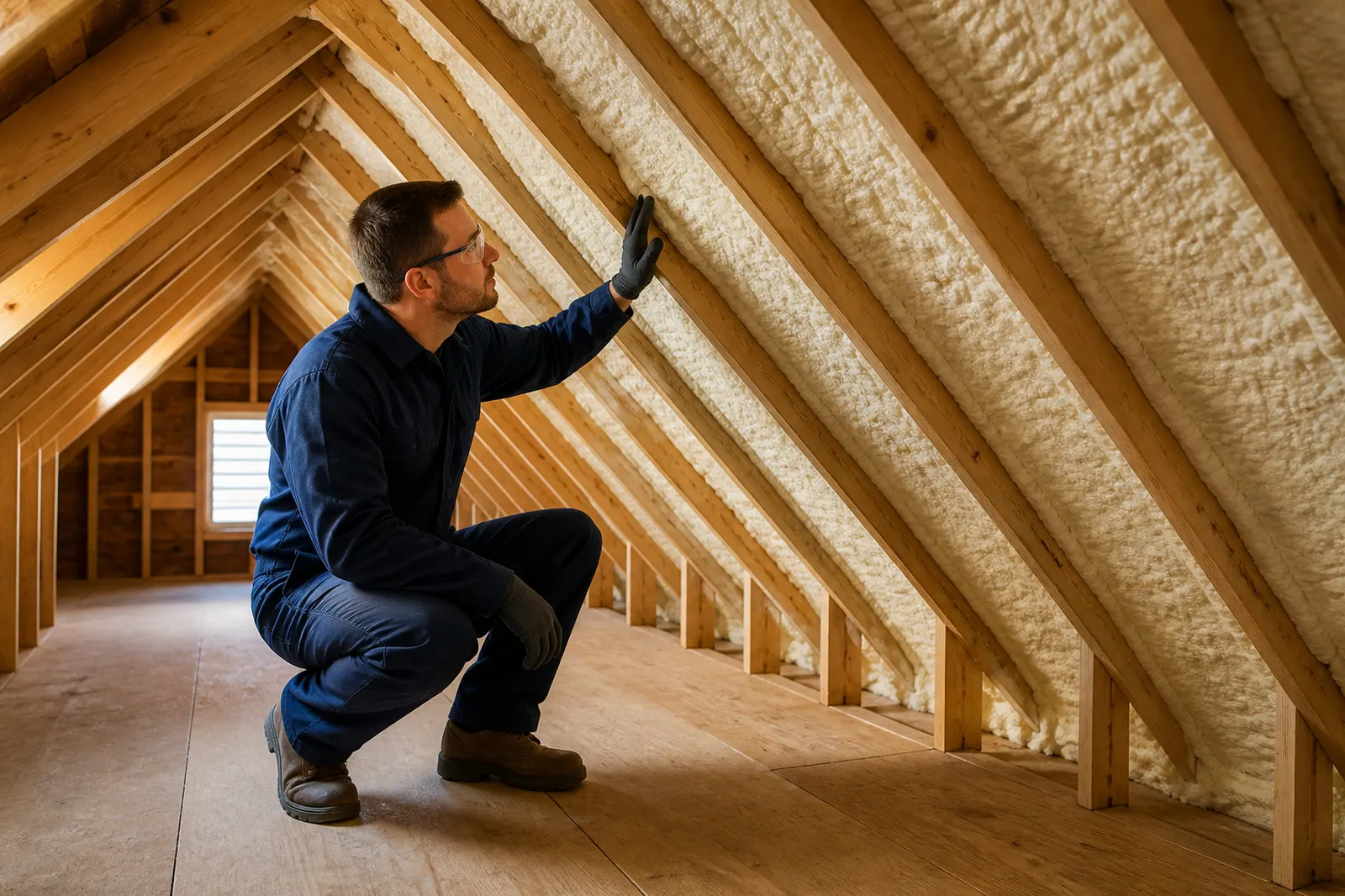
Injection Foam Wall Insulation
Existing wall cavities filled without demolition. Often the natural next step after an attic.Injection foam wall insulation.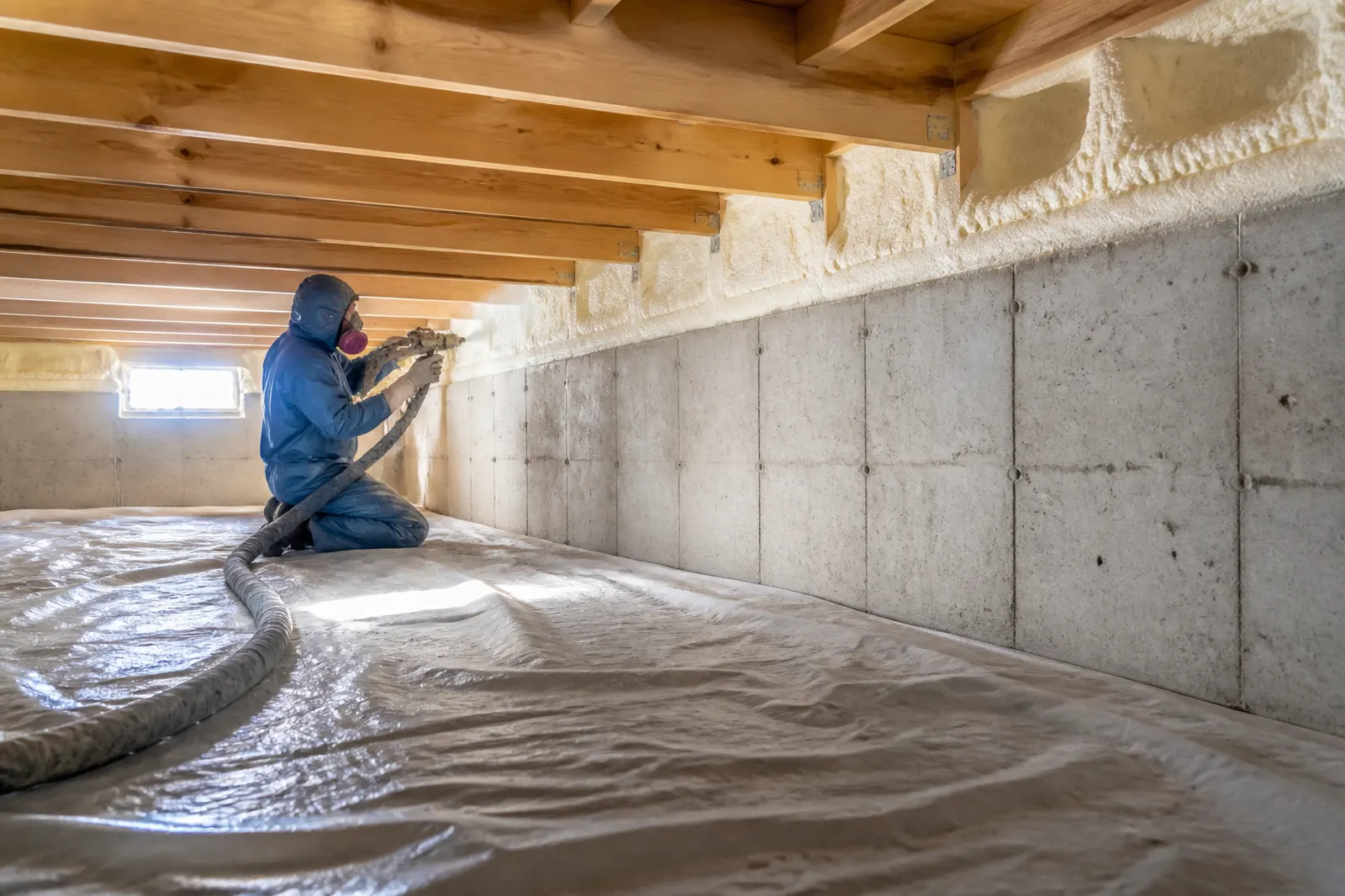
Basement, Crawl Space and Rim Joist Spray Foam
The bottom of the envelope. Doing the top and the bottom together is how a house actually gets tight.Basement, crawl space and rim joist spray foam.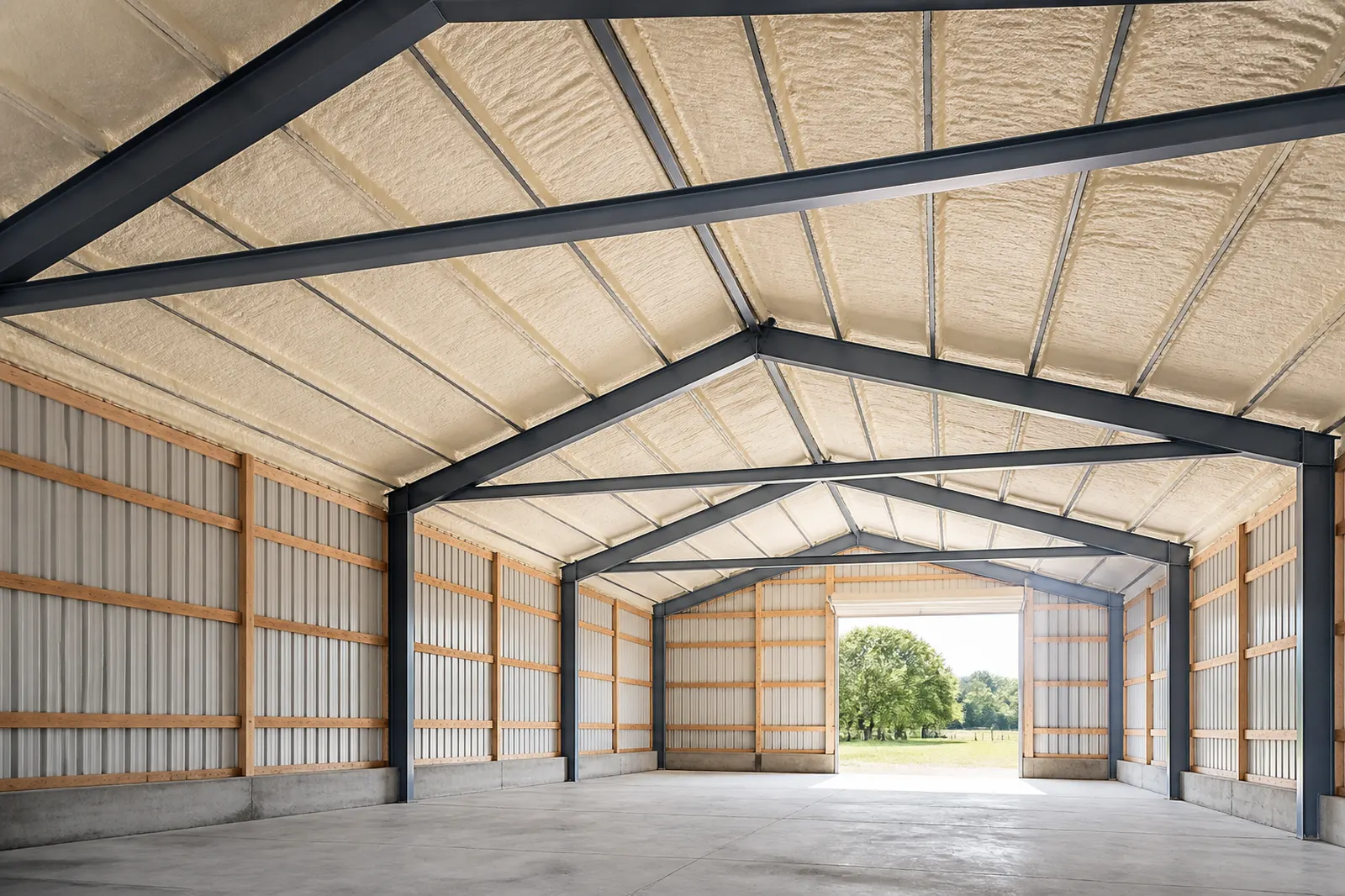
Pole Barn and Metal Building Spray Foam
Workshops, garages, and outbuildings across Broome and Tioga counties.Pole barn and metal building spray foam.Attic Spray Foam Across Greater Binghamton
Johnson City
Steep pitches with short overhangs on close-set lots. Ice damming at the eave is the standard complaint.Vestal
Larger post-war footprints with simpler attic geometry, and a rental corridor where landlord work concentrates.Endicott
Factory-era stock with complicated one-and-a-half-story geometry and knee walls.Endwell
Ranch stock with large, simple, accessible attics, which is often the cheapest and best case for a ceiling-plane job.Why Choose Us
We tell you which plane before we quote either one. Not “we can do either.” A recommendation, with the reasoning, based on what is actually in your attic.
We measure sheathing moisture before we spray. Wood above 18% moisture content should not be foamed over. It takes thirty seconds and almost nobody does it.
We will tell you to do the roof first. If the covering is near end of life, foaming the deck underneath it is a decision you will regret in three years. We say so.
We publish the product data sheet. R-value per inch, re-entry interval, application conditions, in your written scope before you agree to anything.
Photographs of every bay before we spray, and thermal imaging after. Both are yours.
Attic Spray Foam FAQs
Should I foam the roofline or the attic floor?
The roofline if there is ductwork in the attic, the geometry is complicated, or the ceiling below has too many penetrations to seal reliably. The attic floor if the attic is simple, open, empty of mechanicals, and the ceiling plane can genuinely be made continuous. Roofline is usually the more expensive of the two because a roof is usually a larger surface than an attic floor.
There is no universally correct answer, and any contractor who gives you one without going into your attic is guessing.
Will attic foam stop my ice dams?
It addresses the primary cause, which is warm air leaking from the house into the attic and heating the roof deck. That is the right lever. What it does not do is guarantee it, because there can be other heat sources up there, and because if the insulation depth is inadequate the deck can still run warm.
What definitely does not stop ice dams: a new roof. Ice barrier membrane at the eave limits the damage; it does not prevent the dam.
Do I have to remove the old insulation?
For a roofline job, yes. For a ceiling-plane job, often no. It always has to come out if it is wet, rodent-contaminated, vermiculite, or sitting on live knob-and-tube.
Is open-cell foam safe at a roof deck in this climate?
Only with a separate Class II vapor retarder as part of the assembly. Broome County is in climate zone 6, and the residential code requires air-impermeable insulation at a roof deck in zones 5 through 8 to be a Class II vapor retarder or carry a Class II coating. Open-cell is vapor-permeable, so it does not satisfy that on its own.
This is the single most common technical question worth asking a foam contractor, because the answer tells you immediately whether they have read that section of the code.
Will foaming the attic rot my roof deck?
It can, under specific and identifiable conditions, and those conditions are avoidable. The mechanism is interior water vapor diffusing through vapor-permeable foam, reaching cold sheathing, and condensing there. It happens when the foam is too thin, when open-cell is used without a vapor retarder in a cold climate, when the wood was already wet, or when moisture sources like a bath fan venting into the attic are left in place.
It does not happen when the assembly is specified correctly for climate zone 6, the wood is measured before spraying, and the interior moisture sources are dealt with. Building Science Corporation also recommends keeping wintertime indoor relative humidity below 35% in zones 6 and above.
How long do I need to be out of the house?
The interval on the product’s data sheet, which we give you in the written scope. EPA guidance is that occupants vacate during installation and that re-entry waits until the product has cured and the space has been ventilated and cleaned; professional two-component systems commonly cite around 24 hours, though it varies by product.
How long does the job take?
Most attics are one day for the application. Add a day if there is existing material to remove.
Get an Attic Spray Foam Quote
Free property assessment
Get Your Free Foam Insulation Quote
- Free assessment at your property
- Written scope and itemized price
- The product data sheet, attached
- Callback within one business day
Free assessment, in the attic, with a recommendation on which plane and the reasoning behind it. Written scope with the product data sheet attached.
Sources Reference links
- Building America Solution Center, unvented conditioned attic with spray foam below roof deck
- Building Science Corporation BSD-135, Ice Dams
- Energy Vanguard, open-cell spray foam and roof sheathing moisture
- EPA, vacate and safe re-entry time for spray polyurethane foam
- HomeGuide, spray foam insulation cost, 2026